|
Arts
Education & Outreach |
|
|
Seeking
Artists for our Programs! |
|
Tapestry Arts provides arts education in local schools and arts outreach in the neighborhoods.
Arts Education
and Outreach Philosophy
Tapestry supports
learning in and through the arts by:
- Providing
opportunities and access
- Developing
creativity
- Fostering
imagination
|
|
|
2003-2004 Programs
Washington United Youth Center
Sacred Heart Community Center
-
After school program
–Several artists participated in this program including drama,
folklorico dance, visual art and photography.
-
Academic Summer Camp –
The four week curriculum runs parallel to the camp’s academic program
and will include three to four artists.
InnVision – The Villa
Migrant Education
Santa Clara County
Office of Education Alternative Education
-
Alternative
Placement Academy - Muriel
Wright School
-
An eight week,
multi-stage project was established to achieve several artistic,
educational and social objectives with 40 students, ages 14-18 in a
lock-up facility were involved in gourd drum making and wood burning.
Escuela Popular
Fammatre Elementary School
CORAL – Communities Organizing Resources
to Advance Learning
-
Lowell Elementary
-
McKinley Elementary
-
Sherman Oaks Elementary
-
Stonegate Elementary
-
Classes
taught were: Photography, Chinese and African
Multicultural/Multidisciplinary residencies, Visual Art, Aztec dance and
Folklorico dance.
San Jose After
School
|
|
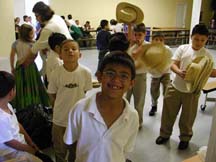
Mexican dance at Escuela Popular |
World Moves – December
2004
This is a 10-week multicultural
dance residency program funded, in part by the Valley Foundation
and Cisco Foundation. For ten weeks students in six San Jose
elementary schools are being instructed in a variety of ethnic
dances. The schools will come together for a culminating event in
December 2004. This year’s participants include Anne Darling
Elementary, Windmill Springs, Olinder School, Escuela Popular,
Sherman Oaks and McKinley Elementary. |
|
The goal of the program is to
teach youngsters about diverse cultures through the universal
languages of the arts. The dances artists teach the students
about the history, music and traditions of their ethnicity through
dance. Native musicians accompany the students in their
performances. Authentic costumes add to the experience. The
schools are selected based on a needs assessment which determines
which schools are underserved in the area of dance, which have an
ethnic diversity which would benefit from this program and which
schools have the physical facility to support the program. The
schools may choose the ethnicity they wish to study. It is
recommended that they select an ethnicity other than the
predominant one of the student body. Lessons are based on the
California State Framework for the Visual and Performing Arts and
assessed in accordance with the State Standards for Arts
Education. |
|
|
|